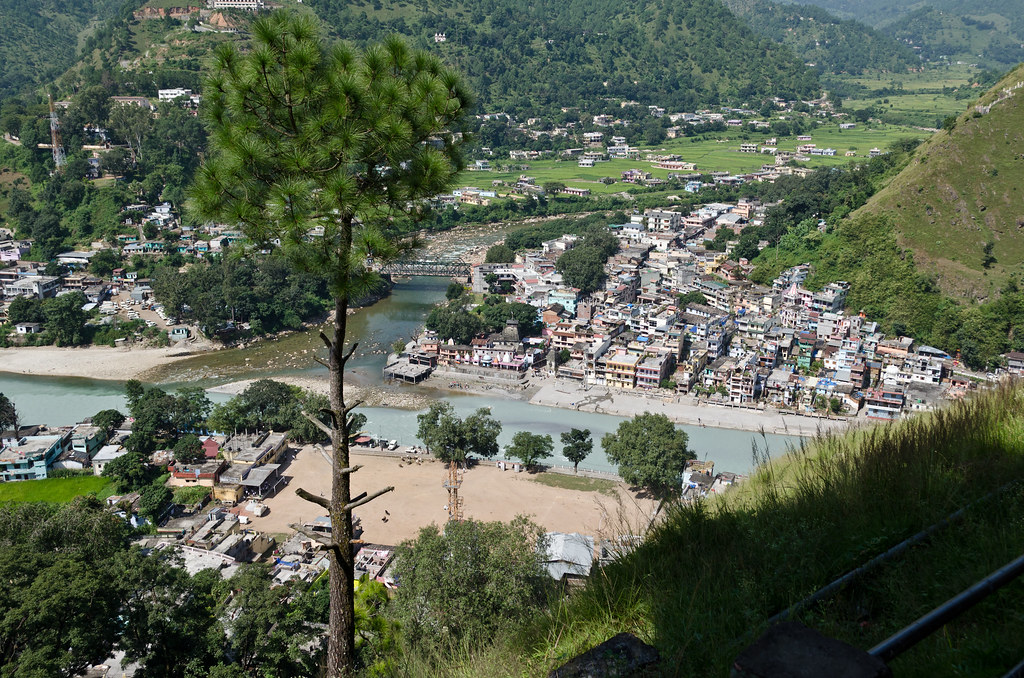
Bageshwar is situated at the confluence of River Saryu, Gomati and the latent Bhagirathi. The town blends religion, nature, culture and adventure and works well as a base for exploring rich Kumaoni landscapes and pilgrimage circuits.
Why Visit Bageshwar:
– Ancient temples and spiritual heritage
– Himalayan river confluences and scenic beauty
– Base for classic treks and exploration
– Offbeat villages and cultural encounters
While the east and west is flanked with Bhileshwar and Nileshwar Mountain range and the sacred Surajkund and Agni Kund located at its South, Bageshwar has the backdrop of the mighty Nanda and Himalayan Ranges.
Bageshwar is a sacred town and finds its mention in Skand Puran. Interestingly the name is traditionally believed to come from “Byagra-Ishwar”, a form of Lord Shiva associated with a tiger-form legend involving Rishi Markandeya and Rishi Vasistha.
History of Bageshwar: According to Skanda Puran, Rishi (sage) Basistha (also referred as Sage Vasistha) was asked to bring down River Saryu by Lord Brahma. But as Rishi Markendaya was meditating on its path it was not possible for Saryu to flow. So Rishi Basistha prayed to Lord Shiva and asked for his help. Lord Shiva took the form of a Lion (Byaghra) and came down on this place along with Maa Parvati (in the form of cow (Gau). The Byaghra (Lord Shiva) attacked the Gau (Maa Parvati) in front of Rishi Markendaya, who after hearing the fight opened his eyes and saved the Gau.
As soon as Rishi Markendaya left his spot, Saryu flowed freely and came down. Lord Shiva in the form of Byaghra (Lion) answered to Markendaya rishi and the pious spot was established as Baghreshwar which later was made Bageshwar. Baghreshwar originally meant the adobe where lord Shiva appeared as Byaghra (Lion) but the term Bageshwar denotes Bag (tiger). Later in 1602, a Chanda dynasty king Laxmi Chanda established the temple of Bageshwar.
Places to see in & Around Bageshwar
Bagnath Temple
Dedicated to Lord Shiva, the Bagnath Temple is located at the confluence of the Saryu and Gomati rivers. The temple features ancient Nagara-style architecture and intricately carved stonework. Built in the early 15th century under King Laxmi Chand of the Chand dynasty, the temple draws devotees especially during Mahashivratri and the Uttarayani Fair.
Sanskrit inscription here confirms the construction details. The main shrine has an idol of Bageswar or Vyagreswar, the ‘Tiger Lord’ – an epithet of Lord Shiva. There are idols of gods and goddesses that date back to 7th & 16th Century. The other important idols are of Chaturmukhi Shiva Linga, Trimurti Shiva Linga and Dasavatar.
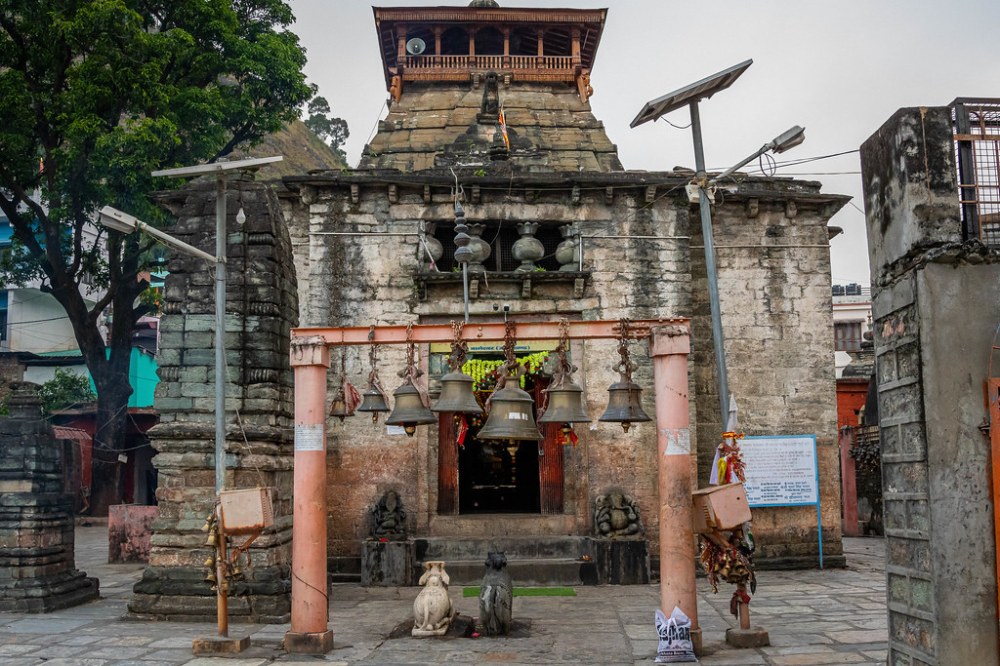
Legends and locals folk tell that the Shiva Linga could not be installed in the temple shrine and whoever tried to do so, were either punished or died. It was finally installed by a local man – Shri Manorath Pandey who belonged to Palayan Village after he performed hard penance and got blessed by lord Shiva himself. Since then the festival of Shivaratri is celebrated here at the temple with a lot of zeal.
The other temples and shrine in this temple complex include Bhairav temple, Dattatreya Maharaj, Ganga Mai temple, Hanuman temple, Durga temple, Kalika temple, Thingal Bhairav temple, Panchnam Junakhara and the Vaneshwar temple are considered notable.
The other important and significant temples that can be visited:
Ramghat Temple, Agni Kund Temple, Mool Narayan Shikhar Temple, Kukuda Mai Temple, Shri Haru Temple, Ram Ji Temple, Chiltha Bhagwati Mata Temple, Jwaladevi Temple, Sitladevi Temple, Venimahadev Temple, Trijuginarayan Temple, Radha krishna Temple, Hanuman Temple, Bhileshwar Dham, Suraj Kund, Swargashram, Siddarth Dham, Gopeshwar Dham, Golu Temple and Praktishwar Mahadev.
Baijnath Temple
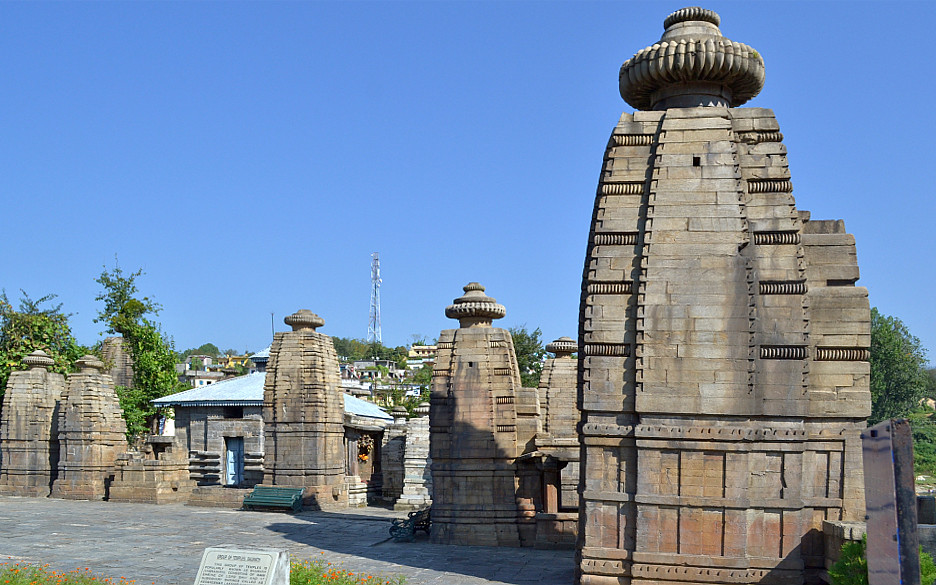
The Baijnath Temple is one of the most significant temple of the state. The temple is 26 km from the main town of Bageshwar in a village called ‘Vaidhyanatha’, which is another name of Lord Shiva. Baijnath Temple is a cluster of 18 ancient stone temples along the Gomati River dates back to the Katyuri period (12th century). Known for detailed carvings and its historical importance, the complex includes shrines dedicated to Shiva (Vaidyanath) and his family.
Read the story behind ‘Baijnath’
According to legend, this story unfolds during the Treta Yuga, when Ravana, the powerful king of Lanka and ruler of the three realms—Earth, Heaven, and the Netherworlds—sought divine blessings to make himself invincible. His devotion led him to Mount Kailash, where he undertook intense penance to please Lord Shiva.
Despite his efforts, Shiva did not appear at first. Determined to demonstrate the depth of his devotion, Ravana performed an extreme act of sacrifice, offering his own heads into the sacred fire, one by one. Moved by this unparalleled display of faith, Lord Shiva finally revealed himself, stopping Ravana before the final offering.
Seeing Ravana wounded by his own penance, Shiva healed him personally. Because the Lord acted as a healer, this form of Shiva came to be known as Vaidyanath—the Divine Physician. Not only did Shiva restore Ravana completely, but he also granted him immense strength and protection.
Overwhelmed with gratitude, Ravana requested that Lord Shiva accompany him to Lanka. Shiva agreed, transforming himself into a Shivling, with one condition: the Shivling must never be placed on the ground during the journey. If it were, Shiva would remain rooted at that very spot forever.
As Ravana carried the Shivling southward, he reached the region now known as Baijnath. There, compelled by human need, he entrusted the sacred Shivling to a local shepherd while he stepped away briefly. Unable to bear its immense weight, the shepherd set the Shivling down on the earth.
When Ravana returned, he tried with all his might to lift it—but the Shivling would not move. Realizing Shiva’s will, Ravana accepted that this land was destined to become a sacred abode. In time, a temple rose around the immovable Shivling, establishing Baijnath as a revered centre of devotion to Vaidyanath Shiva, where faith, legend, and history continue to meet.
According to legends, Baijnath Temple is the place Ravana (King of Sri Lanka) had worshipped Lord Shiva to achieve his invincible powers.
Baijnath does not celebrate Dussehra – Here, Ravana is remembered not as a villain, but as a great devotee of Lord Shiva, whose intense penance led to the establishment of the revered Vaidyanath Jyotirlinga. Out of respect for this association, the ritual burning of Ravana is consciously avoided. This makes Baijnath one of the few places in India where Dussehra is observed through quiet devotion or not marked at all, setting it apart from mainstream celebrations.
You may also be interested to learn about Birthplace of Ravana at Bisrakh
Temple of Bamani
This temple was originally refered as Bharmani and is located just before the main temple complex and right below the Mahanta house. This temple was constructed by a Brahmin Woman who was kidnapped by a Kshatriya. She was a devotee of Lord Shiva and asked him for the expiation of her sins.
Gauri Udiyar Cave Temple
Around 8 km from Bageshwar town, this peaceful natural cave temple is believed to be where Goddess Parvati meditated. Surrounded by forests, it provides a meditative environment and a good detour for nature lovers.
Kapileshwar Mahadev Temple
A short drive from Bageshwar, this Shiva temple is associated with sage Kapil’s meditation, enriching its spiritual environment amidst leafy surroundings.
Offbeat & Less-Explored Gems Near Bageshwar
Sumitranandan Pant Gallery & Kausani Tea Estate
Though a short drive from Bageshwar, these are worthwhile cultural and nature extensions:
- Sumitranandan Pant Gallery celebrates the famed Hindi poet.
- The Kausani Tea Estate offers a serene visit amidst tea gardens with Himalayan views.
Vijaypur (30 km from Bageshwar)
Vijaypur offers you an authentic Kumaoni Village experience along with panoramic views of the snow-capped Himalayan Ranges. Once known as ‘Ora’, the place had tea gardens palnted by the British. Later, the estate was acquired by Vijay Lal Shah, a Gujarati trader, who renamed it after himself! The tea gardens are now managed by the villagers.
KapKot Village (25 km from Bageshwar)
Nestled in peaceful surroundings and offering authentic Himalayan village interactions, KapKot is an under-the-radar destination for travellers who enjoy exploring offbeat countryside locales and interacting with locals.
KapKot is also the last bus terminus if you are traveling towards Pindari Glacier.
Khati Village
Khati is a remote Himalayan village located on the banks of the Pindar River, at an an altitude of 2,210 metres. Nestled within Pindar Valley, Khati is also the last inhabited village on the Pindari Glacier trek route and a crucial stopover for trekkers heading towards Pindari, Kafni, and Sunderdhunga glaciers.
Khati is reached via a trek that begins at Song or Kharkiya village, which is accessible by road from Bageshwar or Kapkot. The trail follows the Pindar River through forests, hanging bridges, and mountain hamlets.
Despite its remoteness, Khati is relatively well-established due to its role as a trekking base, with stone houses, small shops, and basic homestays catering to trekkers.
Bigul & Dhaulinag Temple (32 km from Bageshwar)
The name ‘Bigul‘ comes from the times the Britishers used Biguls (a form of instrument used for announcements). This was used to call out nearby villagers to collect taxes from them.
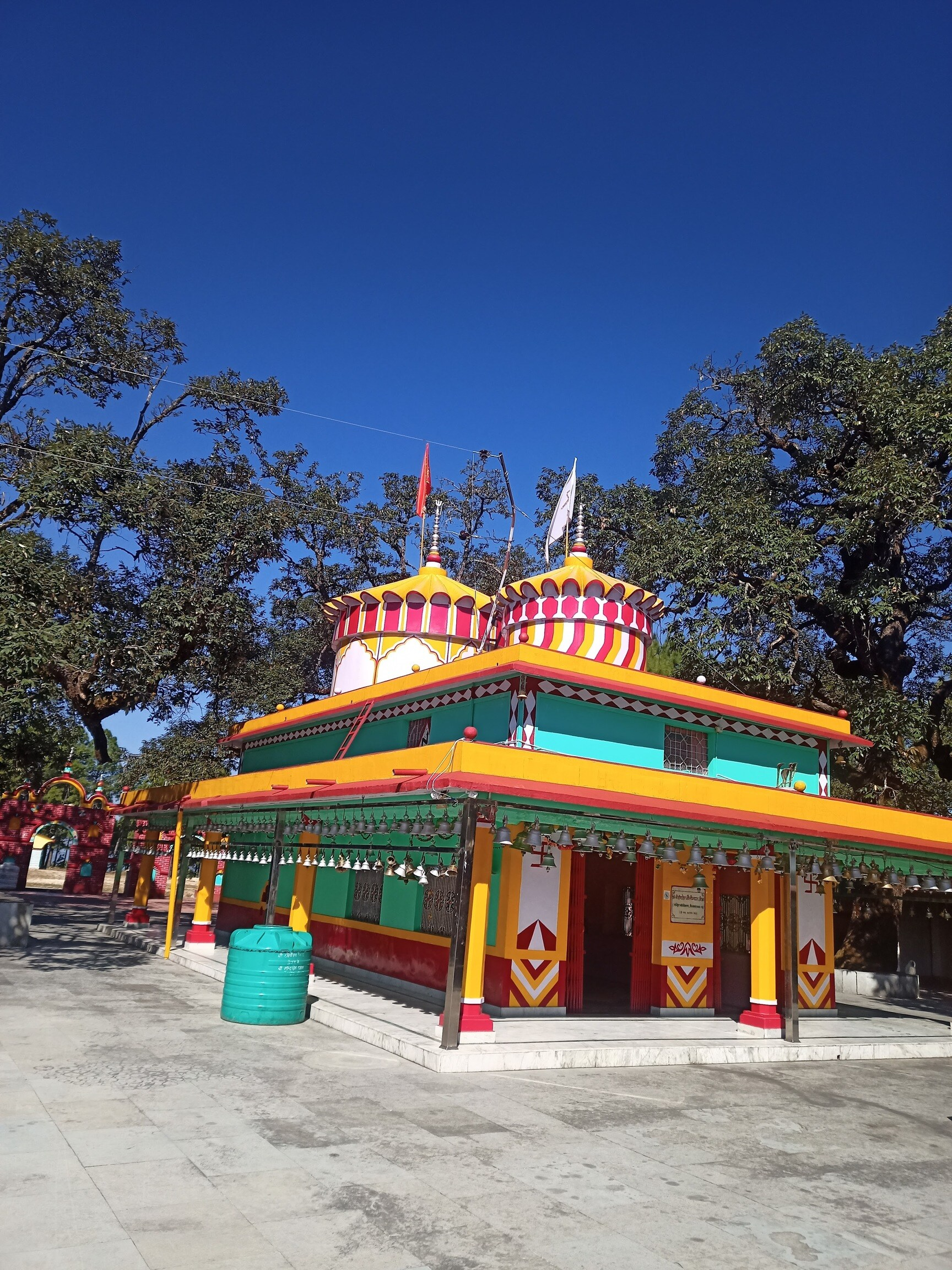
People often visit Bigul for Dhaulinag Temple which is dedicate to Lord Shiva.
Historical Significance of Dhaulinag Temple
According to local tradition, Dhaulinag is believed to be the eldest son of Kaliyanag, who arrived in the Kumaon region to undertake deep penance in devotion to Lord Shiva. In his early presence, Dhaulinag is said to have caused fear and disruption among the local communities. Over time, however, as the people began to worship him with faith and reverence, his nature changed.
Sage Maharishi Ved Vyasa has described the spiritual significance and glory of Dhaulinag (in 83rd chapter of the Manas Khand of the Skanda Purana), highlighting Kaliyanag’s transformation into a benevolent protector of the region.
The name Dhaulinag is derived from the word Dhaval, meaning white, symbolising purity and calm. The shrine dedicated to him is therefore known as the Dhaulinag Temple or the White Snake Temple.
⭐ This shrine is part of a wider and fascinating tradition of Nāga worship that runs deep across the Kumaon hills. The region is dotted with numerous snake temples, each rooted in local belief such as Karkotak Nag Temple of Chhakhata, Vasuki Nag at Danpur, Nagdev and Padmagiri in Salem, and the Sheshnag Temple at Mahar.
Together, these sacred sites form an intricate spiritual network woven into village life and folklore. Local belief holds that Devbhoomi Uttarakhand is home to 108 Nāga temples, a number that reflects completeness and cosmic order in Hindu tradition
Pandusthal Trek
Padusthal has a natural ground over the top of a mountain and is accessible via a 20 km trek from Jakheda (near Garur). It offers a close view of the Himalaya’s and the view is so grand that you can even see the dangling glaciers near the peaks!
How to Reach: There is a bus service from Garur to Jakhera that is opted by trekkers. Another way is to first reach Bageshwar (25 km) or Baisani (15 km) and then take the trek to Pandusthal. It can be done in a day but it is recommended to stay overnight and explore this beautiful spot for a while longer.
Glacier Treks from Bageshwar
The beautiful town is also a delight for adventure sports lovers as the famous Pindari, Sunderdunga, Namik and Kafni Glaciers can be reached via Bageshwar.
Kanda & Sunderdhunga Valley
Kanda village is a scenic upland settlement surrounded by wooded slopes and views of snow-capped peaks. Nearby Sunderdhunga Valley is known as the Valley of Beautiful Stones. It offers trekking, rustic camping and untouched landscapes.
Pindari Glacier Trek
Bageshwar is a key launch point for the Pindari Glacier trek, one of Kumaon’s most classic Himalayan treks that takes around 8 days. he trek has the same start point as the Sundherdunga Valley which is the village of Kahrkia. The route passes through lush valleys, forests and alpine meadows before ending at the glacier at max 3,660 to 3800 m altitude.
Kafni Glacier trek
A quieter alternative to Pindari, the Kafni Glacier trek (also accessed via the same region) is ideal for trekkers seeking solitude and scenery off the beaten path.
Recommended Contact for Trekking

Adventure Plus: is a passionate adventure travel and trekking company founded in 2009 by mountaineering enthusiasts who were also college roommates: Sauraj Jhingan and Samir Patham. Both are determined to help others explore the world’s wild places safely and sustainably. From organising Himalayan treks and high-altitude expeditions to developing experiential outdoor programmes for schools, corporates, and explorers, Adventure Pulse blends adventure with personal growth and discovery.
Location & Distance Guide for Bageshwar
By road: Bageshwar district has a well-developed road network to connect with major cities like Pithoragarh, Chamoli, Rudraprayag, Almora, Nainital and Rudrapur in Uttarakhand state.
- Kausani: 37 km – Kausani is a picturesque hill station famous for its scenic splendor and its spectacular view of the Himalayas.
- Binsar: 48 km
- Almora: 55 km
- Chamoli: 79 km
- Nainital: 89 km
- Rudraprayag: 100 km
By air: Pantnagar airport Udham Singh Nagar is the nearest airport 180 km from Bageshwar town.
Best Time: April – June, and September – November for comfortable weather and clear mountain views.
Trekking Season: Summer months for Pindari / Kafni circuits; monsoon is risky due to rain and landslide possibilities.
Connectivity: The nearest major railhead is Kathgodam; the closest airports are Pantnagar (domestic) and Nainital region connectors for onward road travel.
Feature Image – Bageshwar Town View, Image CC – Flickr – Bijukumar KN
Discover more from GoTravelTrek
Subscribe to get the latest posts sent to your email.

3 thoughts on “Bageshwar: Beyond Sacred Temples”