From fortresses that whisper tales of valor to ancient cave temples, Junnar is a living museum waiting to be explored.
Marvel at the Forts
Shivneri Fort

Perched proudly above Junnar stands Shivneri Fort, the birthplace of Chhatrapati Shivaji Maharaj, founder of the Maratha Empire. The chamber where he was born in 1630 has been preserved as Shiv Mandir, a temple that now serves as a powerful symbol of his enduring legacy. I recently learnt that this chamber also features precise astronomical alignments, where the morning sun’s rays illuminate specific spots across seasons – a testament to the sophisticated architectural knowledge of that era.
As a kid, I remember visiting the fort as part of a day trip and climbing up the Shivneri fort. It was a hot day, and all I can now recall are the water springs (named Ganga and Jamuna) and the huge gates to the fort.
Fascinating details on Shivneri Fort
Vehicles can directly go to the parking area of the fort, which takes approximately 5 minutes to reach from the main gate. This is a significant improvement from earlier times when the fort was difficult to access by vehicle. The main path has 400-500 steps through the gates, taking about 45 to 60 minutes It may take 30-45 minutes for an average person to reach the top.

The fort’s seven gates (Shiv Darwaza, Mena Darwaza, Ganesh Darwaza, Kulumb Darwaja, Pir Darwaja, Hathi Darwaja, and Delhi Darwaja) were not named randomly. Each gate was strategically named and positioned according to ancient Vastu principles, with each representing different aspects of protection and prosperity.
Few are unaware of the intricate network of hidden supply routes carved into the fort’s structure. These routes, known as ‘Chor Darwaza’ (Thieves’ Door) and ‘Ghodyachi Pagdandi’ (Horse Trail), were so well-designed that they remained undiscovered by enemies throughout the fort’s active military history!
The fort has specific spots marked for cultural and administrative activities. There are areas designated for different crafts and skills training Spaces and few are dedicated to scholarly activities and strategic planning.
Other significant forts located near Junnar include Jivdhan Fort, a strategic hill fortress near Ghat Ghar. The Hadsar Fort (approx 13 km from Junnar) is known for its intricately carved rock-cut entrance, and the Chavand Fort. There are dams located nearby, including Yedgaon, Vadaj, Dimbhe, Pimpalgaon, and Manikdoh.
*Jivdhan Fort Trek is quite an adventure, and The Free Bird, a travel blogger, explains it beautifully.
Ancient Caves & Bahmani legacy
Lenyadri Caves
With over 220 rock-cut caves, Junnar has the largest concentration of cave excavations in India. The Lenyadri Caves (just 2 km from Shivneri fort) are a set of 30 Buddhist rock-cut caves, including Cave 7, which houses one of Maharashtra’s Ashtavinayak shrines dedicated to Lord Ganesha. In regional mythology, this is the Girijatmaja cave where goddess Parvati desired to be a mother and where Ganesha was born. In fact, the name “Lenyadri” appears in the Hindu scripture Ganesha Purana as well as in a Sthala Purana, making us believe in Lord Ganesha’s legend.
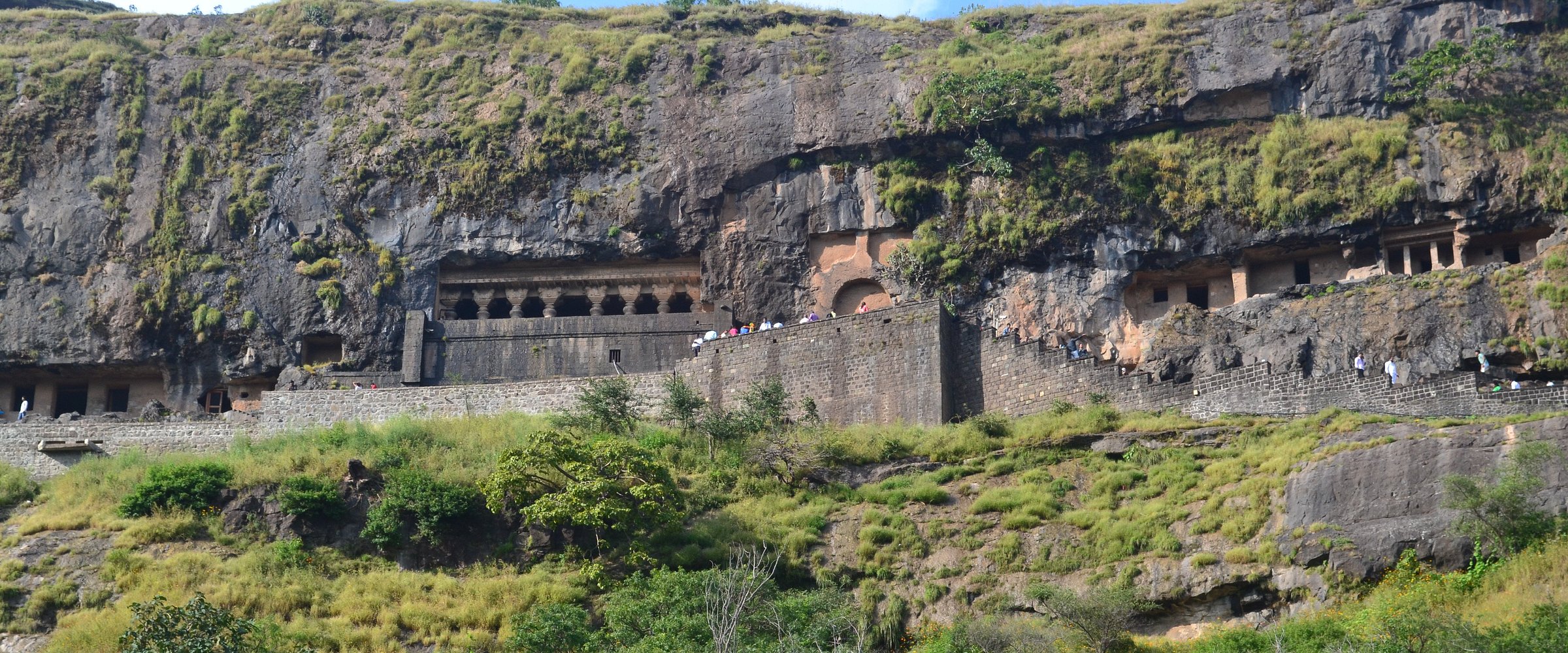
Leyandri Caves can be reached after climbing 307-315 steps, though some sources mention around 300 steps or 338 stairs. While the climb is challenging, especially for those over 50, the combination of spiritual significance, historical importance, and breathtaking views makes it a rewarding experience.
Parking & Entry Fees:
Parking: Approximately ₹50 for private cars (rates may vary)
Entry Fee: ₹10 per person for Indians and ₹200 for foreigners
Doli (palanquin) service is available for approx ₹700, though some sources mention ₹700 for a return trip. If you decide to walk, then the strategy is to take 15-20 steps at a time, then rest before continuing. Stone seats are built around the mountain path for resting.
Total Time: Approximately 45 minutes for a leisurely up-down journey.
Other notable cave clusters include Naneghat Caves, Tulja Leni and Manmodi Caves (3 km from Junnar). Manmodi Caves are further divided into three distinct groups: Bhimashankar, Amba-Ambika and Bhutalinga.
*Blogger Appreciation: I found an interesting blog about all the mentioned caves by Kevin Standage. Please visit his travel photography blog at https://kevinstandagephotography.wordpress.com/2016/05/03/lenyadri-caves-ganesha-lena-junnar
Explore more nearby

Naneghat Reverse Waterfall
Just 30 km from Junnar, the waterfall here flows backward during the monsoon season when the strong winds blow the waterfall’s mist back up the cliff, giving the impression that the water is flowing upward. For adventure treks in and around this region, please visit https://www.treksandtrails.org/collections/reverse-waterfall-trek.
Birdwatching at Pimpalgaon Dam
Birdwatching at Pimpalgaon Dam is a soul-soothing experience, especially in the early mornings when the water turns golden and the hills echo with the sounds of birds. The reservoir attracts a beautiful mix of resident and migratory species, including kingfishers, herons, egrets, and even occasional raptors gliding above. With minimal crowds and vast open views, it’s one of the best spots in the region to slow down, observe nature, and enjoy mindful moments by the water.
Saudagar Gumbaz
This is a 17th-century Indo-Islamic monument in Hapusbaug village, renowned for its stunning post-Bahmani architecture. Junnar region holds historical significance with Yavana (Indo-Greek) inscriptions, marking donations to Buddhist monks, revealing its deep-rooted multicultural heritage.
Another lesser-known wonder at Junnar is its underground water chain system, particularly at Sayyed Wada (Nehr-e-Hussaini Hauz), built in remembrance of Karbala. Interestingly, this ancient water reservoir remains functional to this day.
Stay options at Junnar
HmmBrr Resorts, in Junnar, Maharashtra, is a humble venture with a raw and rustic setting, where one can experience the stillness of nature.
Website: https://hmmbrr.com
Malshej Agro Tourism & Farm: Nestled in the picturesque Sahyadri mountain ranges with breathtaking views of the exotic Malshej Ghat, Malshej Agro Tourism offers the perfect escape from urban chaos. From luxury farm villas that offer peace and quiet in expansive living spaces to well-maintained dormitories perfect for groups and solo travellers, they cater to every traveller’s needs.
Website: https://malshejagro.com
Location & Distance Guide
From Fofsandi: 1 hr 23 min (44.8 km) via Udapur-Muthalane Rd
Pune: 2 hr 55 min (94.5 km) via NH60
Best time to visit: August – February
Discover more from GoTravelTrek
Subscribe to get the latest posts sent to your email.

One thought on “Junnar – a destination steeped in heritage”