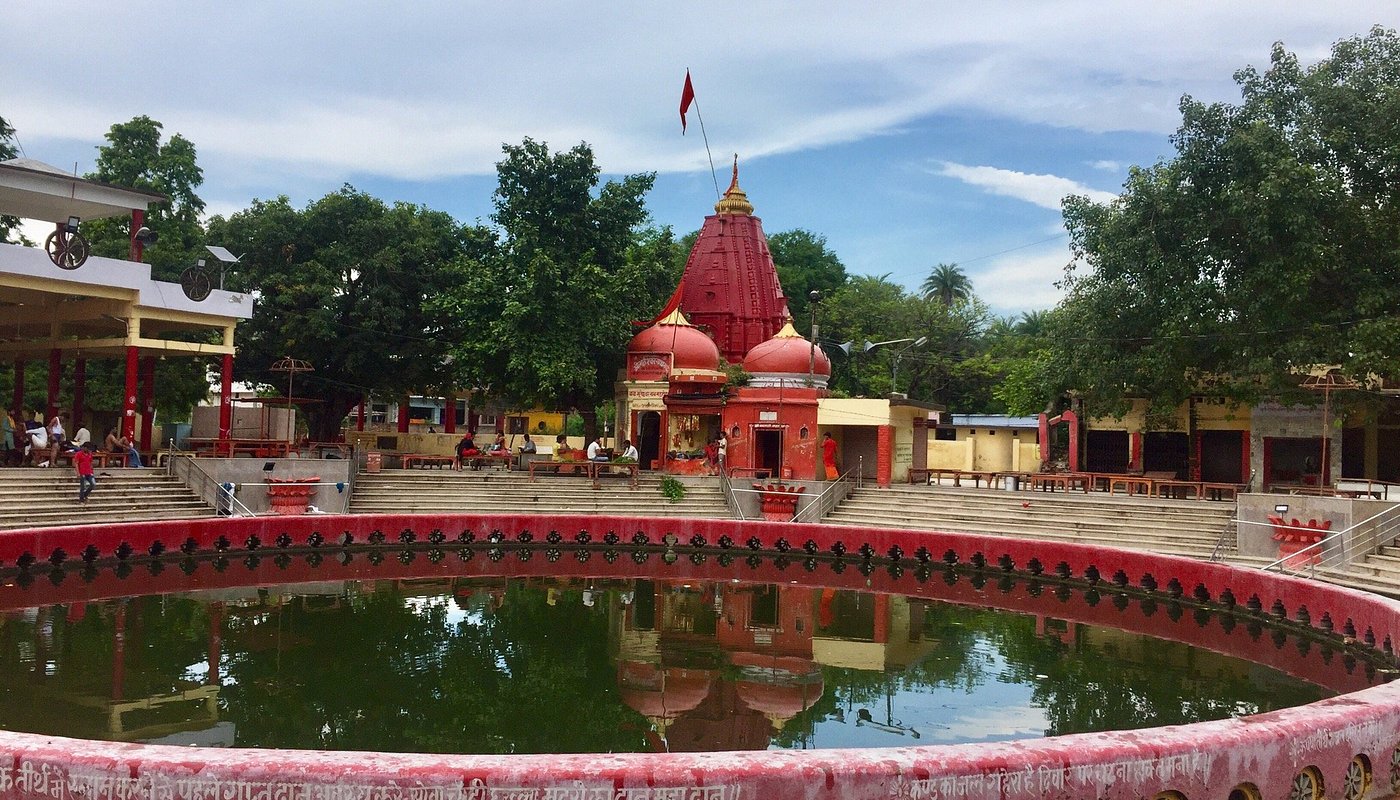
Naimisaranya beckons you with its tales of devotion and valor, enveloping you in a spiritual embrace. Embark on a soul-stirring journey to Naimisaranya, a hidden gem nestled in the heart of Uttar Pradesh, India.
History of the place
The Legend of Indra and Vritra: Once upon a time, the mighty asura named Vritra drove Indra, the king of the devas, out of Devaloka (heaven). Vritra was invincible due to a powerful boon that rendered him immune to all known weapons until the day he received the boon. Moreover, no wood or metal weapon could harm him.
Desperate to reclaim his kingdom, Indra sought solace from Brahma, who advised him to perform penance to Lord Vishnu in the mystical Naimisaranya forest. He devoted himself to penance for an incredible 2000 years.
The Divine Revelation: At the culmination of his penance, Lord Vishnu appeared before Indra at the exact spot where the divine Vishnu Murti (self-manifested idol) now stands inside the temple’s garbha griha (sanctum). Vishnu enlightened Indra that only a weapon crafted from the bones of the sage Dadhichi could defeat Vritra.
Dadhichi’s Noble Sacrifice: Indra sought the sage Dadhichi’s aid, whom he had previously beheaded. Dadhichi agreed to help the devas, but he expressed a wish to embark on a pilgrimage to all the holy rivers before giving up his life for their cause. In a remarkable feat, Indra gathered the waters of all the sacred rivers and brought them to Naimisaranya, fulfilling Dadhichi’s wish without delay.
The Birth of Vajrayudha: Dadhichi, through the art of yoga, selflessly surrendered his life, and the devas fashioned the powerful Vajrayudha (thunderbolt weapon) from his spine. This formidable weapon would be used to defeat the asura Vritra, leading to Indra’s triumphant return as the king of Devaloka.
The place is also referred to as Nemisharan, Naimisaranya, Neemsar, Naimish, Nimkhar, Nimsar, and Naimisaranyam.
Exploring the Naimisaranya Temple
The Naimisaranya Vishnu Temple stands as a testament to this ancient saga. With its exquisite architecture blending South Indian and North Indian styles, the temple exudes an aura of divine grace. As you step inside, you’ll be captivated by the golden-hued Garud stambh, facing the sanctum of Lord Vishnu, accompanied by an intricately engraved murti of Garuda. Shri Naimishnath temple is one of the Divya Desams. The main deity is Lord Devaraja Perumal. This temple is one of the eight Swyambhu Kshetras of Lord Vishnu. The temple remains open from 6.00 AM to 8.00 PM.
The Sacred Sanctums
Within the temple, you’ll find three garb grihas dedicated to Lord Vishnu, Goddess Lakshmi, and Ramanujacharya, arranged nearby. The main sanctum houses a magnificent standing murti of Lord Vishnu, black in colour, while a secondary murti stands beside him. Both are adorned with silver ornaments, radiating a divine elegance.
Goddess Lakshmi’s Abode
The shrine dedicated to Goddess Lakshmi features a brown murti of Shri Mahalaxmi (Pundarika Valli), an achal vigrah (immovable idol), adorned in red clothes and silver ornaments. Two other devi murtis grace either side, adding to the temple’s celestial beauty.
Adjacent to the revered Hanuman Garhi Temple, Naimisaranya invites pilgrims and spiritual seekers to purify themselves by taking a holy dip in its sacred well, particularly on the auspicious new moon day. Legend has it that a bath on such a day can wash away a lifetime of sins, especially when offering prayers to the nearby deity Lalita.
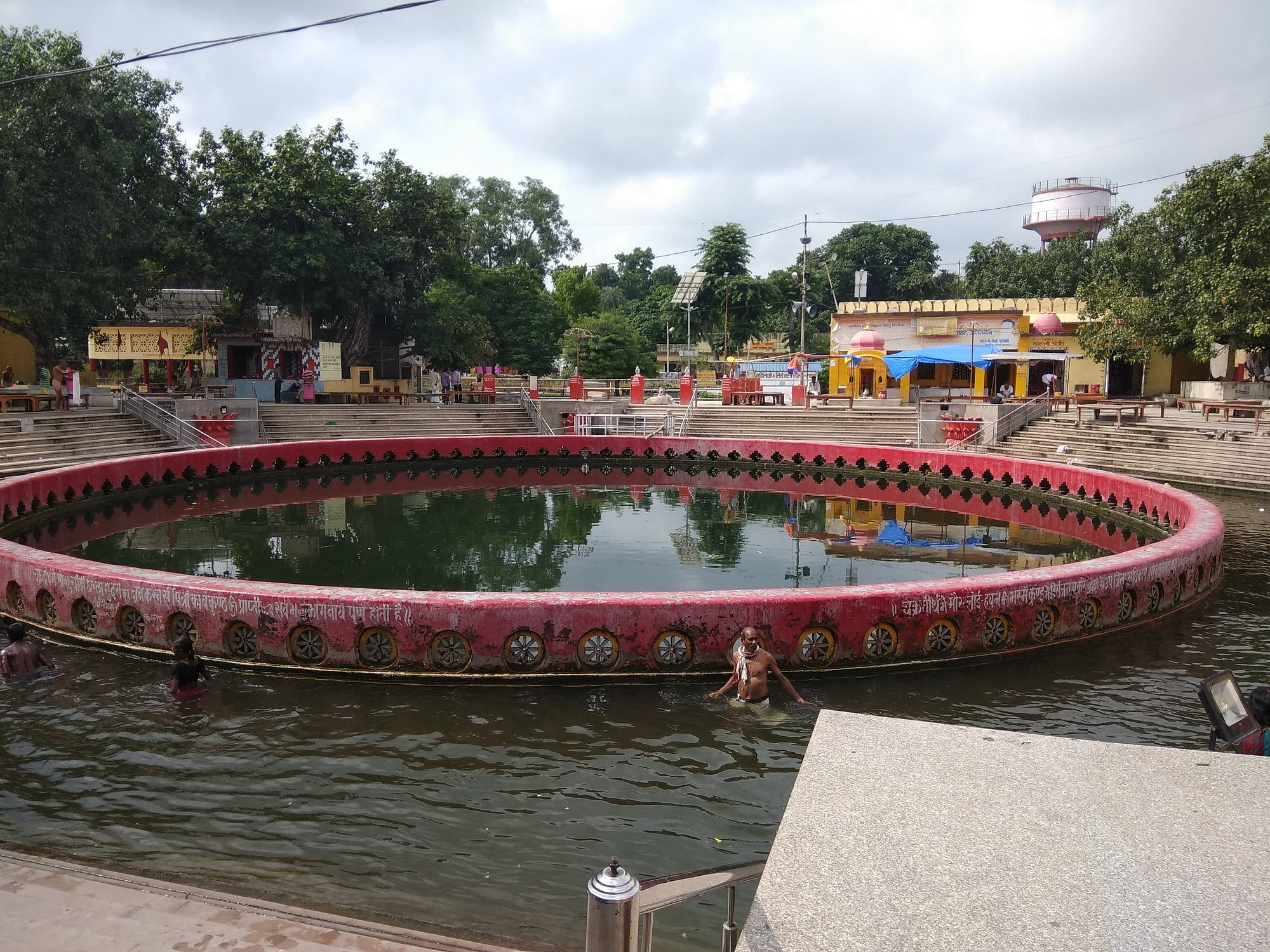
Witness the Miraculous Chakra Tirth
At the heart of Naimisharanya lies the extraordinary Chakra Tirtha, a river that flows in a circular motion, with water originating from an underground source and mentioned in many of the Vedas. This circular pond is believed to have been formed by the Chakra of Mahavishnu, with overflowing water used by pilgrims for holy baths. The Bhagavat Purana declares there is no sacred place on earth that compares to Naimisharanya, with Chakra-Tirtha considered the centre of the universe.
According to legend, the wheel (Chakra) of Lord Brahma made an opening in the earth, resulting in the creation of this enormous body of water. The large sweet-water spring that feeds into Chakra Kunda is said to be bottomless, adding to the site’s mystical aura.
A Journey Through the Yugas
The concept of four primary Tirthas corresponding to the four Yugas represents a beautiful spiritual framework; however, it’s essential to note that this is based on traditional beliefs rather than historical documentation.
In this sacred chronology, Naimisharanya represents the primordial age of truth (Satyuga), when divine knowledge was first revealed to humanity. According to mythology, Naimisharanya is as old as time itself, with its significance bestowed upon saints through the ages.
The Birthplace of Sacred Literature – Four Vedas
It is believed that the four Vedas – Rig Veda, Yajur Veda, Saam Veda, and Atharva Veda – were written here, along with all 18 Mahapuranas and six Shastras. Naimisharanya is the place where many Hindu scriptures and legends were composed or narrated, including the Vedas, the Mahabharata, the Ramayana, and the Puranas.
It was here that Romaharshana (Lomaharshana), Vedavyasa’s disciple, narrated the Puranas to several Rishis, and where Ugrasrava (Suta Gosvami) narrated the story of Shreemad Bhagavatam to assembled sages. Sages like Ved Vyasa, Shaunak Rishi, and Narada Muni are said to have meditated here, turning the forest into a timeless reservoir of spiritual wisdom.
The six Shastras traditionally associated with this sacred site are Sankhya, Yoga, Vedanta, Nyaya, Mimamsa, and Vaisheshika – the foundational philosophical systems of Hindu thought. The legendary Satyanarayan Katha is also believed to have been first spoken here by Ved Vyasa to Suta, who then shared it with Shaunak and other assembled Rishis.
A Living Spiritual Heritage
Naimisharanya has a 16-kilometre circumambulatory path that incorporates all of India’s sacred sites, making it a microcosm of the entire subcontinent’s spiritual geography. The place is unique due to the belief that it is the land where the pantheon of 33 Hindu gods & goddesses resides.
Today, Naimisharanya continues to draw pilgrims and spiritual seekers who come to experience this timeless sanctuary where, according to tradition, the eternal wisdom of the Vedas first echoed through the forest groves, establishing it as one of India’s most sacred and historically significant spiritual destinations.
Location & Distance Chart
- Naimisharanya to Lucknow: 92 kms – Lucknow Railway Station is also the nearest major railway station connected to almost all major cities of India.
- Nearest Airport: Chaudhary Charan Singh International Airport, Lucknow (115 km)
- Hardoi: 40 kms
- Sitapur: 35 kms
- Ayodhya: 175 kms
- Mathura/Vrindavan: 200 kms
- New Delhi: 545 kms
- Haridwar/Rishikesh: 450/500 kms
All Images Copyright @Tripadvisor
Discover more from GoTravelTrek
Subscribe to get the latest posts sent to your email.
