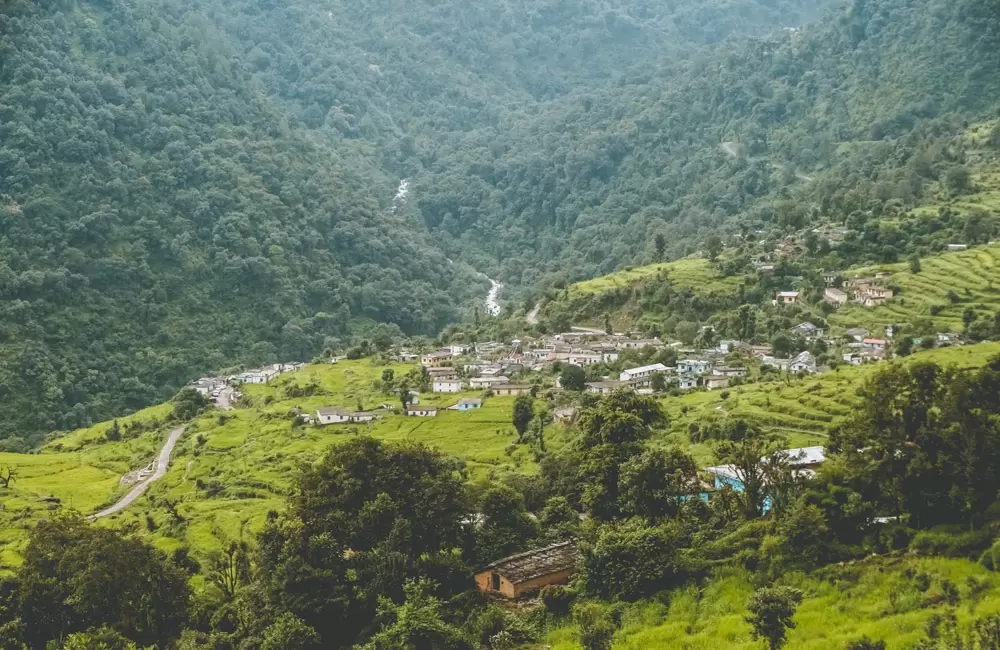
Byunkhi is a quaint village located near Rudraprayag, Uttarakhand. Byunkhi isn’t a sightseeing destination. It is a living Himalayan village where life flows with the seasons, crops, rituals, and mountain weather. If you’re drawn to mindful travel, rural stories, or vanishing village cultures, Byunkhi will reward you.
In fact, it was only in 2022 that the village of Byunkhi was connected via a motorable road.
Why travel to Byunkhi, Uttarakhand
– Place demon Raktbheej was killed by Goddess Kali
– Unspoiled beauty
– Rural charm: genuine culture and lifestyle of a traditional Himalayan village
– Offbeat travel destination
- Spectacular Himalayan vistas include the Chaukhambha, Himbuk, Kedar, Madhyamaheshwar, Tungnath, Kartik Swami, and Deoria Tal.
Places to see in and around Byunkhi
Kalimath
Kalimath is one of India’s 108 revered Shakti Peeths, dedicated to Goddess Kali. The temple is on the banks of the Saraswati River, at an altitude of 6000 feet; cradled in nature’s embrace.
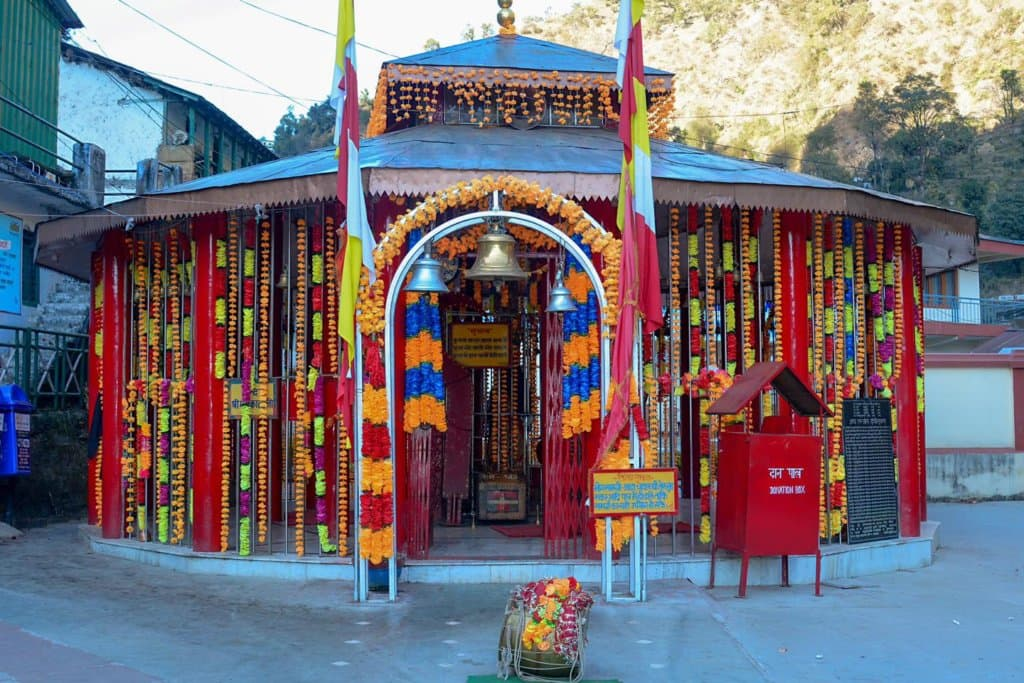
According to local lore, it was here that Goddess Kali, after killing the demon – Raktabeej, merged back within the earth. Here, a sacred silver plate known as the Sri Yantra, shrouded in mystery and reverence, holds a place of honor. This mystical artifact is unveiled only once a year, on the eighth day of Navratri, a major Hindu festival. In a secretive midnight ceremony, the chief priest alone performs puja (worship) before the exposed Sri Yantra.
From Kalimath, you can also travel a bit further to visit Chaumasi; another offbeat village experience. Chaumasi reflects the everyday rhythms of Garhwali village life, largely untouched by mainstream tourism.
Koti Maheshwari/Ruchh Mahadev
The Koti Maheshwari Temple is located at the confluence of two rivers (River Kham and River Saraswati) and is approx. 15 km from Guptkashi and 5 km from Kalimath.
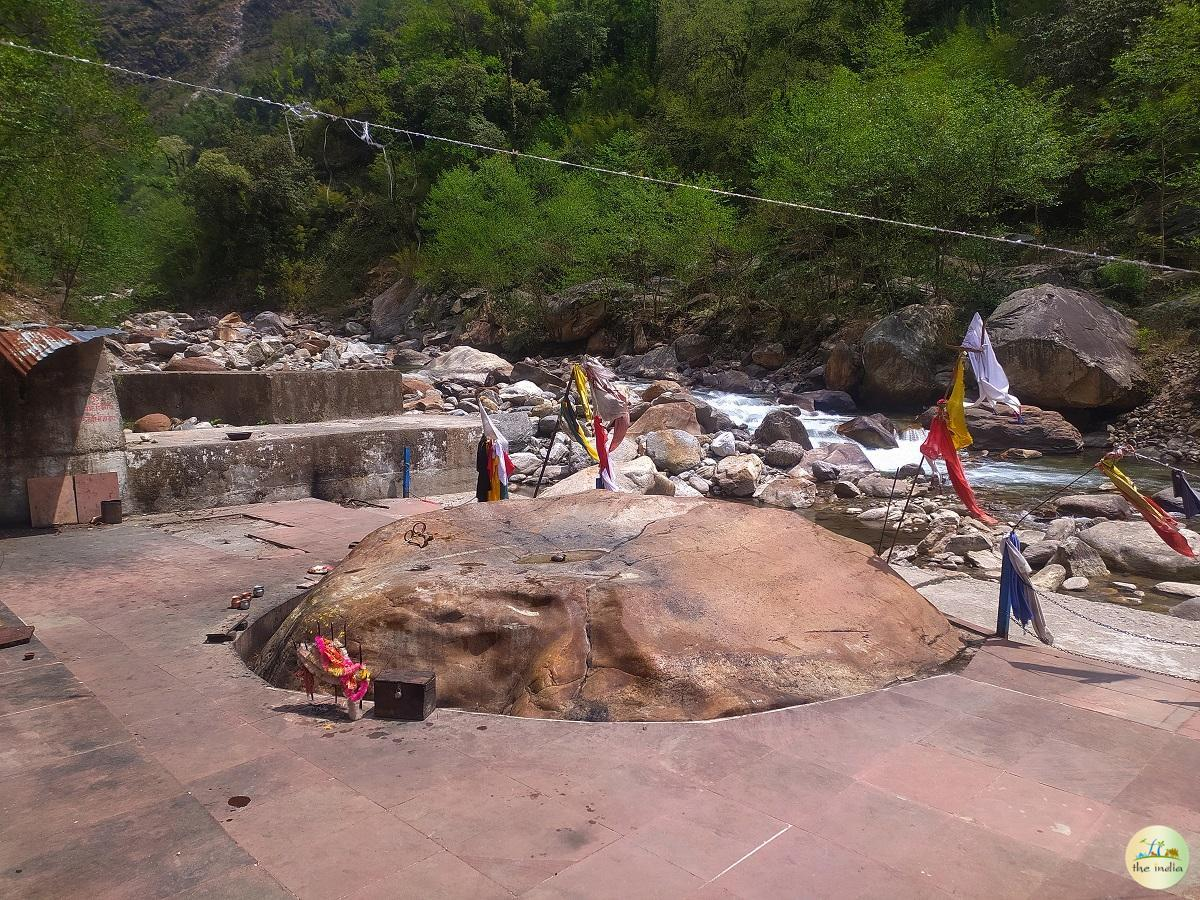
Ruch Mahadev is also known as Ardh Gaya and its importance is similar to that of Bodhgaya, Bihar. Ruchh Mahadev Temple is a lesser-known but deeply revered Shiva shrine. Local belief holds that Shiva manifested at this site to grant refuge and protection to devotees during times of hardship.
The shrine is simple in structure, with a stone sanctum housing a Shiva linga. Rituals are performed mainly by local priests, and worship follows Garhwali customs rather than elaborate temple protocols. Special prayers are offered during Shravan month, Maha Shivaratri, and regional festivals.
Best way to explore this region
1. Guptkashi to Ukhimath
Most travellers enter the region via Guptkashi, an important spiritual and logistical hub on the Kedarnath route. A visit to the Vishwanath Temple here sets the devotional tone of the journey. From Guptkashi, a scenic mountain drive leads to Ukhimath, perched on a ridge overlooking the Mandakini valley.
Ukhimath is a significant winter seat of worship, where the idols of Lord Kedarnath and Lord Madmaheshwar are housed during the snowbound months. The Ukhimath (Ushamath) Temple is central to the religious life of the region and serves as a key base for exploring surrounding villages and trails.
2. Ukhimath to Byunkhi Village
From Ukhimath, the route descends and winds through forested slopes to reach Byunkhi village that retains its traditional Garhwali character. Surrounded by terraced fields and dense woodland, Byunkhi offers a slower rhythm and your gateway for the Kalishila trek.
Staying in Byunkhi allows travellers to acclimatise, engage with village life, and prepare for the sacred walk ahead.
3. Byunkhi to Kalishila (Trek)
The 3 km trek from Byunkhi to Kalishila is short but spiritually charged. The trail ascends through forested terrain and opens onto dramatic valley views. Kalishila itself is marked by a striking black rock formation and a shrine dedicated to Goddess Kali.
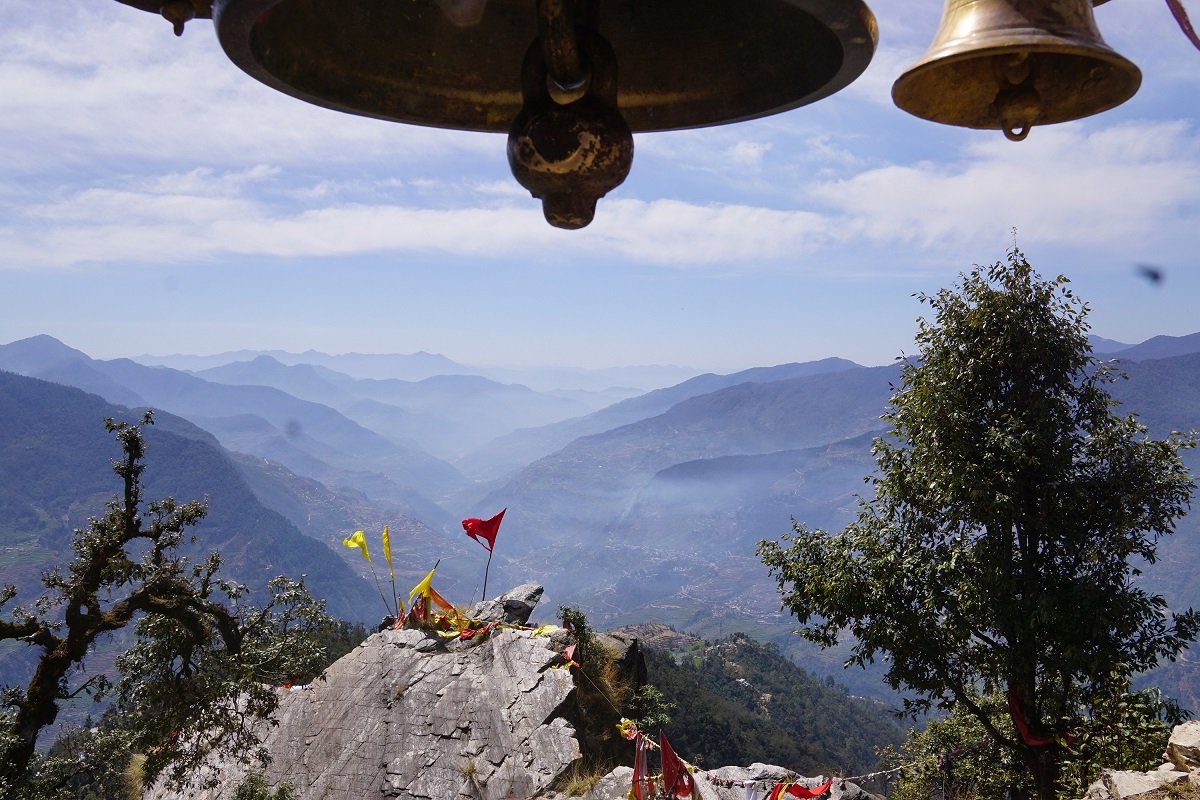
Regarded as a powerful Shakti site, Kalishila is associated with ancient legends of Kali’s manifestation and tantric worship. The absence of elaborate structures heightens the sense of elemental worship, making this stop more about presence than performance.
The mythological story about Raktabeej
According to regional Puranic traditions and Garhwal folk narratives, this area was once associated with the reign of the Asura brothers Shumbh and Nishumbha , whose kingdom is believed to have extended across nearby settlements, including Mansuna village. Alongside them was the formidable demon Raktabeej, whose near-invincibility arose from a terrifying boon: every drop of his blood that touched the earth gave rise to a new demon. His defeat proved impossible through conventional means, plunging both the celestial and earthly realms into chaos.
Continue reading….
In response to the pleas of the Devas, Goddess Parvati is said to have manifested her fierce aspect, giving rise to Goddess Kali. Local tradition holds that Kali emerged from black rock itself, rather than descending from the heavens, reinforcing the belief that Kalishila is not merely a battlefield but a site of manifestation.
Legends recount that Kali reached the region in three great strides, finally arriving near present-day Kalimath, where she confronted Raktabeej. To prevent the demon’s blood from touching the ground, Kali expanded her mouth and consumed both Raktabeej and every form that emerged from his spilled blood, ending the cycle of regeneration and restoring cosmic balance.
However, Kali’s fury did not immediately subside. As described in Shakta lore across India, Lord Shiva intervened, placing himself in her path. When Kali stepped upon him, she recognised her consort, and her rage dissolved. In this moment of realisation, Kali is believed to have merged back into the earth, disappearing at the very site now revered as Kalishila.
The shrine is closely associated with 64 sacred Yantras, a number traditionally linked to Shakta Tantra and the 64 Yoginis. These yantras are believed to represent cosmic forces rather than physical idols, reinforcing Kalishila’s identity as a tantric power centre rather than a conventional temple.
One of Kalishila’s most striking features is a large black rock formation, angled sharply at approximately 45 degrees, projecting outward from the mountainside. Embedded within or emerging from this rock is a natural crystal formation, locally identified as the Sri Yantra. Unlike sculpted yantras found in temples, this formation is considered self-manifested (swayambhu) and is visible on the far side of the rock, facing the valley below.
Pilgrims believe this point marks a convergence of cosmic energies, where earth, form, and consciousness intersect. The absence of elaborate ritual structures enhances the site’s intensity; worship here is quiet, elemental, and deeply personal.
Local oral tradition further sanctifies Kalishila as the place where Goddess Sati was reborn as Parvati, adding another layer of meaning to the site. This belief links Kalishila not only to Kali’s fierce intervention but also to the cycle of dissolution and rebirth, central to Shakta cosmology.
4. Ukhimath to Sari & Makku Villages
Returning to Ukhimath, the route continues towards Sari and Makku villages, both known for their well-preserved Himalayan architecture and traditional lifestyle. Stone houses, slate roofs, and terraced farms define the landscape.
Sari village is 68 km far away from Chopta.
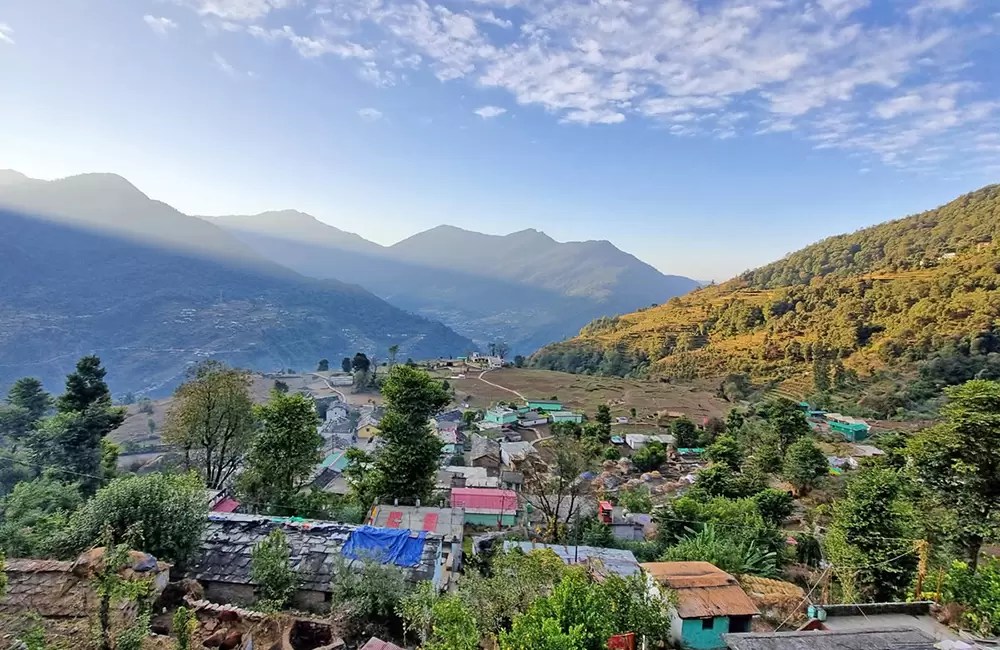
Sari village is particularly important as the starting point of the Deoriatal trek, while Makku or Makkumath is known as the winter abode of Tungnath Idol (worlds’ highest Shiva Temple), adding another layer of religious significance to the circuit.
5. Sari to Deoriatal (Trek)
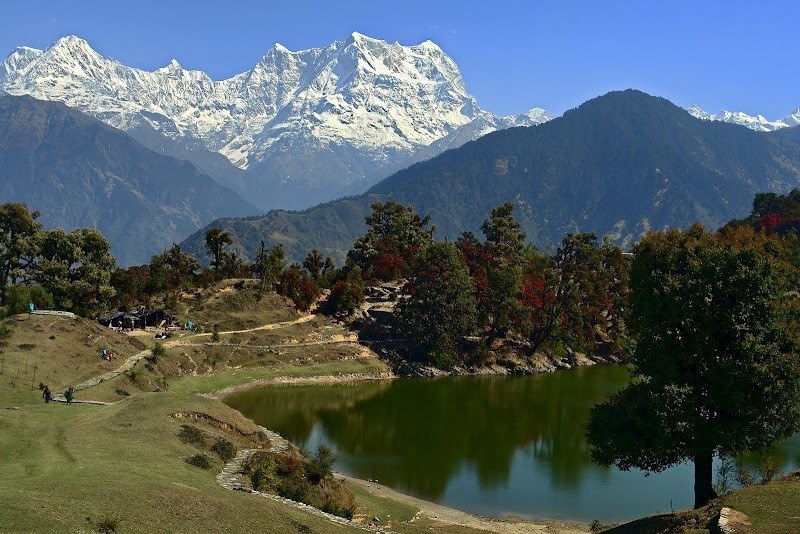
A well-marked 3 km trek from Sari village leads to Deoriatal, a high-altitude emerald lake set amidst forest clearings. The trail is gentle and suitable for beginners, making it one of the most accessible Himalayan lake treks.
Deoriatal is famed for its early-morning reflections of the Chaukhamba massif, when the peaks mirror perfectly on the still water. For many travellers, this becomes the visual highlight of the journey.
6. Deoriatal – Extended Trek Options
From Deoriatal, more adventurous trekkers can extend their route towards Bisuri Tal, continue through Rohini Bugyal, and reconnect with Chopta. This extended loop links lakes, meadows, and forest corridors, eventually merging with the Tungnath–Chandrashila trail system.
7. Chopta to Tungnath Temple & Chandrashila Trek
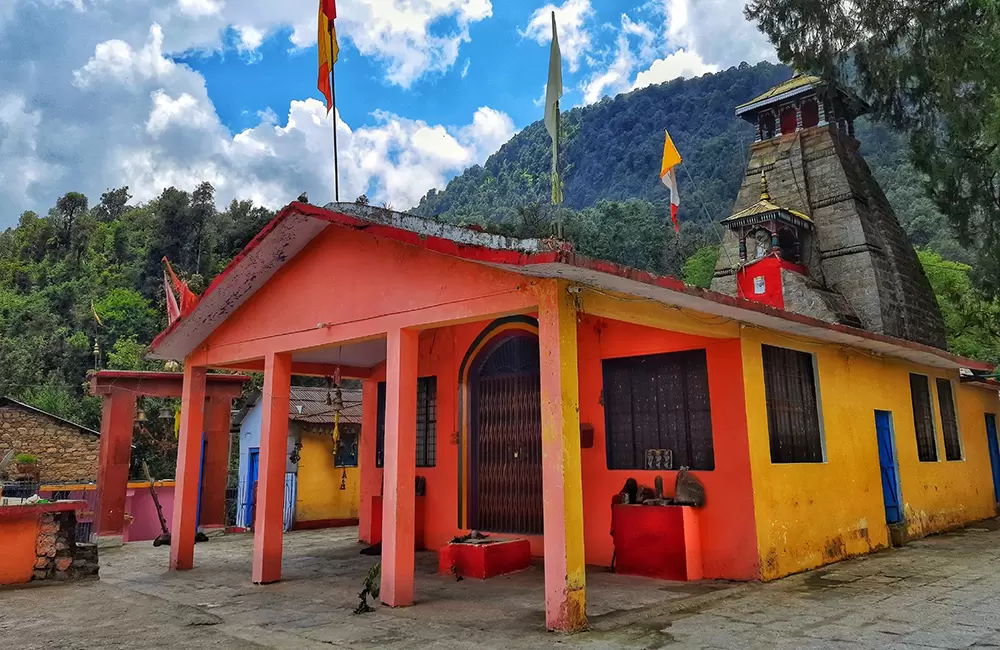
Chopta serves as the primary base for high-altitude treks in the region. From here, travellers can ascend to Tungnath Temple, the highest Shiva temple in the world, and continue further to Chandrashila summit, which offers panoramic views of the Garhwal Himalaya.
The trek to the Chandrashila peak is 5 km. The trek begins from Chopta to Tungnath, which is 3. 5 km long trek route, from here, Chandrashila is 1.5 kilometer away, and a steep trek. Though shorter in distance but steep climbing makes this trek rigorous.
Chopta also provides access to quieter trails leading to Atri Muni Falls, Anusuyamata Temple, and the lesser-known Bisudital, making it suitable for both first-time trekkers and those seeking solitude. Mandal Village, Chamoli is the starting point to cover both these temples and my blog : : Mandal Village shares more details.
8. Optional Detours: Trijuginarayan & Madmaheshwar
If you have some extra time, you can cover these too.
- A detour to Trijuginarayan offers insight into its mythological significance as the wedding site of Lord Shiva and Goddess Parvati, marked by an eternal sacred fire.
- The trek to Madmaheshwar Temple, starting near Raunlek village, takes travelers deep into alpine terrain. The temple is 15 km from the main and is closely connected to the Kalishila region through shared pilgrimage traditions.
Local Food to try:
Most villages still follow the old ways of farming and rely much on simple, seasonal, and nourishing food. Do try:
- Mandua (finger millet) roti
- Jhangora ki kheer
- Aloo ke gutke
- Seasonal saag
- Fresh buttermilk, herbal teas
If you have more days, you may explore nearby villages including:
- Kotma (2 km)
- Uniyana (3 km)
- Maikhanda (3 km)
- Bhetsem (3 km)
- Jaggi Bagwan (3 km)
Location & Distance Guide to Byunkhi
Ukimath (winter seat of Kedarnath and Madhyamaheshwar deities): 35 kms
Rudraprayag: 55 km
Dehradun: 124 kms
Best time to visit: May to June and Sep-Nov
*Travel tip: Ask locals in Ukhimath for the latest road condition as landslides in the area can temporarily alter access especially during monsoon.
*There are no hotels and only a few homestays available, so stay options can be found in nearby towns of Rudraprayag and Ukhimath.
All images copyright @google
Discover more from GoTravelTrek
Subscribe to get the latest posts sent to your email.
