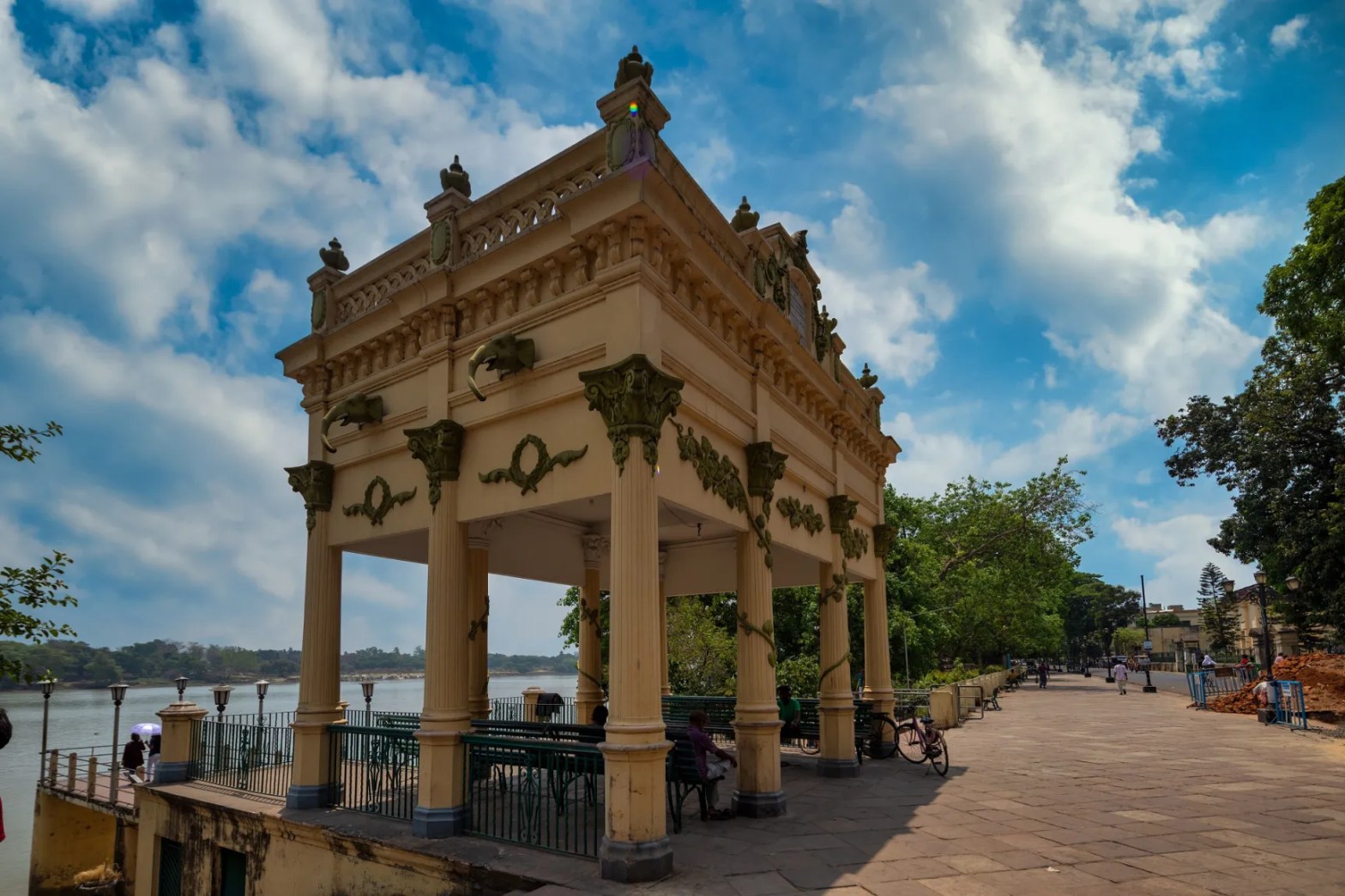
A quiet suburban town, this place is a slice of Pondicherry, yet so different. Established in 1673, Chandannagar (also referred to as Chandannagor or Chandernagore) is a small town that has witnessed the French Colonial Rule in India as well as the struggles under the British Rule.
Once a French colony, the town still retains charming colonial architecture, riverfront promenades, old cemeteries, and quiet lanes.
History of Chandannagar
It was Ibrahim Khan, the Nawab of Bengal, who granted Chandannagar to be converted to a French Trading Post, while Bengal was still under the Mughal Empire.
In 1688, it became a permanent French settlement. Then in 1730, Joseph François Dupleix was appointed the governor of the city, and he transformed the town’s landscape by building more than 2,000 brick houses, enhancing the maritime trade. But soon after, in 1756, a war broke out between France and Great Britain, and Chandannagar was captured by Colonel Robert Clive of the British East India Company and Admiral Charles Watson of the British Navy on 23 March 1757 (Battle of Chandannagar). Most of the town’s fortifications and houses were demolished during this time. The town was restored to French control again in 1763, but was retaken by the British in 1794 in the Napoleonic Wars.
The city was returned to France in 1816, along with a 3-square-mile enclave of surrounding territory. It was governed as part of French India until 1950, under the political control of the governor-general in Pondicherry, even after India’s independence in 1947. India gained independence from Britain in 1947, and in June 1948, the French Government held a plebiscite, which found that 97% of Chandernagor’s residents wished to become part of India. In May 1950, the French allowed the Indian government to assume de facto control over Chandernagor, officially ceding the city to India on 2 February 1951. The De jure transfer took place on June 9, 1952.
On 2 October 1954, Chandernagor was integrated into the state of West Bengal. (excerpts taken from https://anilvohraphotography.wordpress.com/2015/09/17/chandernagore
Explore Chandannagar
The Strand (Riverfront Promenade)
- A tree-lined riverside walk is one of the most popular things to do here. Its peaceful, especially at sunset.
- Along the Strand, you’ll spot colonial buildings, memorials, and a strong French architectural feel.
- At Jora Ghat (on the Strand), you can watch boats drift on the Hooghly.
Sacred Heart Church
A stunning Roman Catholic church built in 1884. It was designed by French architect Jacques Duchatz, and is one of the most iconic heritage buildings in the town.
Patal‑Bari (“Underground House”)
This curious house has a lower floor that gets submerged when the river level rises. Historically, notable figures, including Rabindranath Tagore and Iswar Chandra Vidyasagar, have stayed here.
Chandannagar Museum / Institut de Chandernagor
A museum housed in a former French administrative building. It showcases antiques, cannons, furniture, letters, and other artefacts from the French colonial era. Interestingly, the institute still runs French classes!
French Cemetery
Located on the Grand Trunk Road opposite Lal Dighi. It contains tombs of early French colonists, including Duplessis and meteorologist Henry “Storm” Piddington.
Clock Tower / Strand Clock
A landmark tower on or near the Strand, built during colonial times. Today, it is a photogenic piece of heritage and a popular gathering point.
Nandadulal Temple
It is a temple dedicated to Lord Krishna. Built in 1740, the temple is known for its terracotta art.
Experience like the locals
Catch the locals gossiping about their daily life, stroll around to discover the bylanes of this fascinating town and marvel at its hidden heritage buildings.
Try ghoti gorom, a popular street food made with heated sev, spices, chopped onions and lemon juice. Do not miss out on the indigenous smoked Bandel cheese!
You can’t miss eating the sweets when here. Try jolbhora sandesh, lyangcha, pantua, and mishti doi.
Recommended Blogs
- Sumit Walia has penned an interesting blog on her trip to Chandannagar. Go check it out at https://traveldreams.live/chandannagar-history-present/experiences-travel-n-beyond/2022.
- For some fantastic pictures and details about Chandannagar, visit https://www.sepiaeye.com/serena-chopra-chandernagor-a-legacy-of-french-heritage
Location & Distance Chart
From Kolkata: 35 kms
From Vidyasagar Setu: 54 kms
Feature Image Copyright @Sumit Walia
Discover more from GoTravelTrek
Subscribe to get the latest posts sent to your email.

Vivid, colourful and detailed write up – brought up visual frames of the places in my mind. Thanks for sharing
LikeLike
I am glad you liked it. I glanced at this place while in Kolkata last year but never knew much till I read yours and Nat Geo Traveller’s short guide. Thank you for clicking those amazing pictures. I am sure people would love to explore this fascinating little treasure and travel there to rediscover the rich heritage.
LikeLiked by 1 person
True. There is a yesterday’s Europe along on the banks of Hooghly. The Portuguese at Bandel, the Dutch at Chinsurah and the Danish at Serampore are all nearby..maybe you could cover those in your next visit. All the best !!
LikeLiked by 1 person
There is a piece of wrong information provided regarding the image of the ‘Hotel de Paris’. It is currently the Chandannagar Sud Divisional Court not Institute de Chandannagor. Please do correct it.
LikeLiked by 1 person
Thanks Mr. Ghosh. I have updated the pic details and would love to hear more about this building. Also share a few recent pics if u are living in the vicinity.
LikeLike